Vast majority of publications are under
-
Eye Pose Estimation and Tracking Using Iris as a Base Feature
IEEE Open Journal on Immersive Displays (vol. 2, pp. 96-105, 2025)
Abstract
A novel, fast, and robust method for 3D eye pose tracking that leverages the anatomical constancy of the human iris to improve accuracy and computational efficiency is proposed. Traditional pupil-based methods suffer from limitations due to pupil size variability, decentering, and the need for complex corrections for refraction through the corneal bulge. In contrast, the iris, due to its fixed size and direct visibility, serves as a more reliable feature for precise eye pose estimation. Our method combines key advantages of both model-based and regression-based approaches without requiring external glint-producing light sources or high computational overheads associated with neural-network-based solutions. The iris is used as the primary tracking feature, enabling robust detection even under partial occlusion and in users wearing prescription eyewear. Exploiting the consistent geometry of the iris, we estimate gaze direction and 3D eye position with high precision. Unlike existing methods, the proposed approach minimizes reliance on pupil measurements, employing the pupil’s high contrast only to augment iris detection. This strategy ensures robustness in real-world scenarios, including varying illumination and stray light/glints/distortions introduced by corrective eyewear. Experimental results show that the method achieves low computational cost while maintaining state-of-the-art performance.
Near-eye display optic deficiencies and ways to overcome them
Proceedings Volume 11765, Optical Architectures for Displays and Sensing in Augmented, Virtual, and Mixed Reality (AR, VR, MR) II; Event: SPIE AR VR MR, 2021
Abstract
The key aspect of AR/VR is immersivity. Immersivity occurs when all the senses are engaged. When designing a near-eye display to supply immersivity to the most important sensory system – the human visual system - the challenge is to obtain both high imaging quality and compactness.
Conventional optical designs are unable to resolve the mutually contradictory requirements for modern AR/VR systems, such as achieving low weight / small footprint / low cost while at the same time providing higher resolution and reduced optical aberrations.
Eye-tracking real-time measurements can be used to modify the near-eye display visual data and to augment optical system performance, reducing the distortions caused by the physical constraints of AR/VR systems.
In this paper, we describe typical AR/VR optical system deficiencies and present methods to overcome them with the help of eye-simulation and eye-tracking. These methods provide a higher effective image resolution with reduced optical aberrations, resulting in improved image quality and a more immersive user experience.
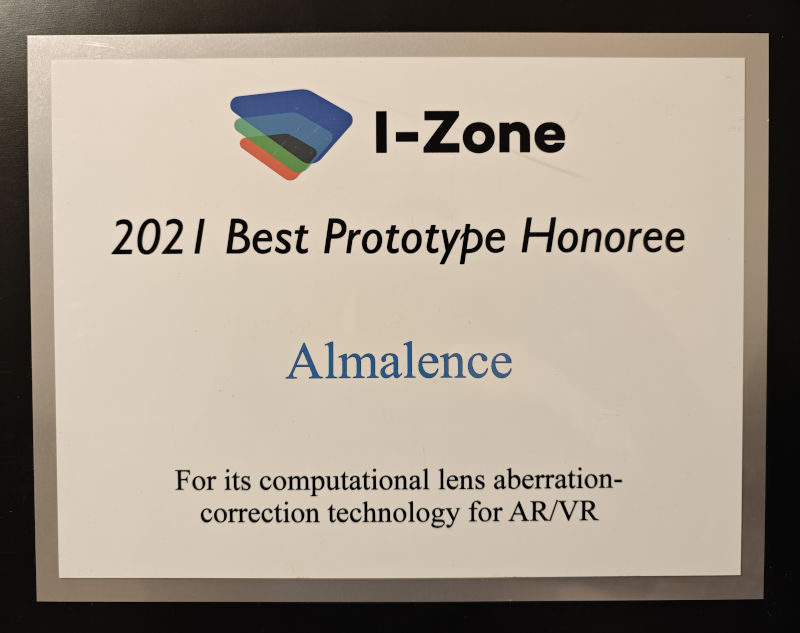
SID Display Week 2021 Best Prototype Honoree